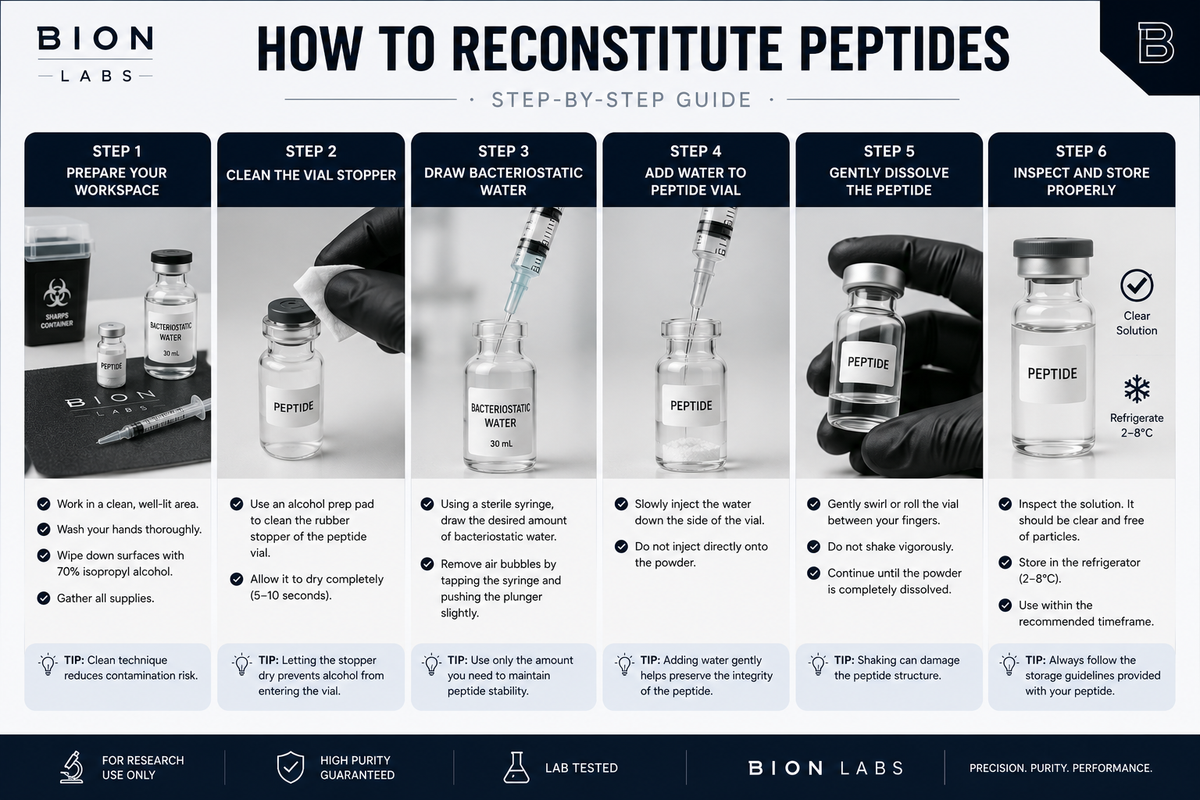
How to Reconstitute Peptides Properly | Complete Research Guide by BION LABS
What Is Peptide Reconstitution?
Peptide reconstitution is the process of dissolving a lyophilized (freeze-dried) peptide powder into a sterile liquid solution before laboratory research use.
Most research peptides are supplied in lyophilized form because freeze-drying helps preserve molecular stability, purity, and shelf life during storage and transportation. Before use in research settings, the peptide must be carefully reconstituted using an appropriate sterile solvent.
At BION LABS, all research compounds are provided in lyophilized format to help maintain product integrity, consistency, and long-term stability.
Why Proper Peptide Reconstitution Matters
Correct peptide reconstitution is critical for:
- Maintaining peptide stability
- Preserving molecular integrity
- Preventing contamination
- Achieving accurate concentration calculations
- Supporting consistent laboratory handling
- Reducing degradation caused by improper mixing
Improper reconstitution techniques may damage delicate peptide chains, alter pH balance, reduce stability, or cause aggregation.
Supplies Needed for Peptide Reconstitution
Before starting, prepare all required materials.
Essential Equipment
- Lyophilized peptide vial
- Bacteriostatic water
- Sterile syringe
- Sterile needle
- Alcohol prep pads
- Clean workspace
- Disposable gloves (recommended)
- Refrigerator (2–8°C)

Best Solvent for Reconstituting Peptides
Bacteriostatic Water
Bacteriostatic water is the most commonly used solvent for peptide reconstitution.
It contains sterile water with 0.9% benzyl alcohol, which helps reduce bacterial growth after opening.
Benefits of Bacteriostatic Water
- Helps maintain sterility
- Suitable for multi-use research vials
- Compatible with most peptides
- Improves storage stability
- Widely used in peptide research environments
For most research compounds, bacteriostatic water is considered the preferred option.
Sterile Water for Injection
Sterile water contains no preservative.
It may be used in certain laboratory applications, but because it lacks antimicrobial protection, reconstituted solutions typically have a significantly shorter usable window.
Acetic Acid Solutions
Certain peptides with difficult solubility profiles may require dilute acetic acid solutions during initial dissolution.
This is more common with specific growth factor analogs or peptides with hydrophobic regions.
Only experienced laboratory professionals should handle specialized solvent protocols.
Step-by-Step Guide: How to Reconstitute Peptides

Step 1 — Prepare a Clean Workspace
Start by thoroughly cleaning your workspace.
Wash hands thoroughly and sanitize the working area using 70% isopropyl alcohol.
A clean environment helps reduce contamination risk and protects peptide stability.
Step 2 — Inspect the Peptide Vial
Before reconstitution, inspect the vial carefully.
The peptide should appear as a white or off-white lyophilized powder or compact peptide cake.
Do not use the vial if you notice:
- Moisture inside the vial
- Discoloration
- Cracks or seal damage
- Visible contamination
Step 3 — Clean the Vial Stoppers
Use alcohol prep pads to sanitize the rubber stoppers on:
- The peptide vial
- The bacteriostatic water vial
Allow both surfaces to fully air dry before proceeding.
Step 4 — Draw the Bacteriostatic Water
Using a sterile syringe and needle, slowly withdraw the desired amount of bacteriostatic water.
The amount added depends on the desired final concentration.
Common examples:
|
Peptide Amount |
Water Added |
Final Concentration |
|---|---|---|
|
5mg |
2mL |
2.5mg/mL |
|
5mg |
5mL |
1mg/mL |
|
10mg |
2mL |
5mg/mL |
|
10mg |
5mL |
2mg/mL |
Step 5 — Inject the Water Slowly
Insert the needle into the peptide vial and slowly allow the bacteriostatic water to run down the inner wall of the vial.
Do not inject the liquid directly onto the peptide powder.
Slow reconstitution helps:
- Reduce foaming
- Minimize peptide stress
- Prevent aggregation
- Preserve structural integrity
Step 6 — Allow the Peptide to Dissolve Naturally
Most peptides dissolve naturally within several minutes.
Avoid aggressively shaking the vial.
Instead:
- Gently swirl
- Slowly roll the vial
- Allow the solution to rest
Vigorous shaking may damage sensitive peptide structures.
Step 7 — Refrigerate Immediately
After reconstitution, store the peptide inside a refrigerator between 2–8°C.
Avoid:
- Direct sunlight
- Heat exposure
- Frequent temperature fluctuations
- Freezing reconstituted peptides unless specifically required
Proper storage helps maintain stability and consistency.
How Much Bacteriostatic Water Should You Add?
The amount of bacteriostatic water depends entirely on personal laboratory preference and the desired final concentration.
Adding more water does not increase peptide quantity.
It only changes concentration and draw volume.
Basic Concentration Formula
Concentration = Total Peptide Amount ÷ Total Liquid Volume
Example:
- 10mg peptide + 5mL water = 2mg/mL concentration
- 5mg peptide + 2mL water = 2.5mg/mL concentration
Researchers often choose concentrations based on easier measurement and handling.
Common Mistakes During Peptide Reconstitution

Shaking the Vial Aggressively
Many peptides are delicate molecular structures.
Aggressive shaking may increase instability or aggregation.
Always use gentle swirling instead.
Using Incorrect Solvents
Not every peptide behaves the same.
Using improper solvents may reduce solubility or compromise peptide integrity.
Poor Sterile Technique
Contamination is one of the most common reasons for compromised peptide solutions.
Always:
- Use sterile equipment
- Clean vial tops
- Avoid touching needles
- Work in a clean environment
Incorrect Storage Temperatures
Heat exposure accelerates degradation.
Reconstituted peptides should generally remain refrigerated.
How Long Do Reconstituted Peptides Last?
Stability varies depending on:
- The peptide itself
- Storage conditions
- Solvent used
- Temperature exposure
- Handling procedures
Research environments commonly store reconstituted peptides refrigerated at 2–8°C.
Avoid repeated warming and cooling cycles whenever possible.
Should Peptides Be Frozen?
Lyophilized peptides are generally more stable than reconstituted peptides.
Long-term storage of lyophilized peptides may involve freezer storage depending on the compound.
However, repeatedly freezing and thawing reconstituted peptide solutions may negatively impact stability.
Always follow compound-specific handling protocols.
Frequently Asked Questions
What Does Lyophilized Mean?
Lyophilized means freeze-dried.
This process removes water from the peptide while helping preserve molecular structure and long-term stability.
Why Is Bacteriostatic Water Preferred?
Bacteriostatic water contains benzyl alcohol, which helps reduce bacterial growth after opening.
It is widely used for peptide reconstitution in research settings.
Can Peptides Be Mixed Quickly?
Slow and controlled mixing is generally preferred.
Rapid shaking may reduce stability in certain peptides.
Why Are Peptides Stored Refrigerated?
Lower temperatures help slow degradation and maintain peptide stability.
Are BION LABS Products Intended for Human Use?
No.
All products sold by BION LABS are strictly intended for laboratory research and analytical purposes only.
Products are not approved for human consumption, therapeutic use, diagnostic use, or veterinary use.
Final Thoughts
Understanding how to reconstitute peptides correctly is essential for maintaining peptide integrity, sterility, and consistency during laboratory handling.
Using proper solvents, sterile technique, controlled mixing methods, and appropriate storage conditions helps preserve the quality of research compounds.
BION LABS remains committed to providing premium research compounds manufactured with a focus on purity, consistency, and scientific standards.
Research Use Only Disclaimer
All products available on www.biionlab.com are sold strictly for laboratory research and analytical purposes only.
Products are not intended for human consumption, medical use, therapeutic application, diagnostic procedures, or veterinary use.
Researchers are responsible for handling all compounds according to appropriate laboratory standards and regulations.